About

John Newman has a long history working in agriculture and engaging with Native American tribes…
The tribes John has been involved with include the Washoe, Cheyenne, and Miwok. He studied creative writing and biology at Stanford, owned a working ranch near Harlowton, Montana, and for many years served as Chairman of the Museum of the American Indian in Marin County, California. He divides his time between Melville, Montana, and northern California.
John grew up in rural northern California…
He worked in agriculture and later owned a working cattle and wheat ranch near Harlowton, Montana, about which he wrote a history, “Tipi Ring Ranch, Before and After the Buffalo.” He studied creative writing and biology at Stanford, worked as a river guide on the great rivers of North America, and for over a decade has been a fire lookout. His interest in native affairs and culture began at an early age when he helped construct the Ishi trail to honor the last surviving member of the Yahi tribe. He also studied the Washoe language with the tribe near Lake Tahoe, their ancestral home, and for many years served as Chairman of the Museum of the American Indian in Marin County, California. While ranching in Montana he became acquainted with the neighboring Cheyenne tribe, sweated with families, and was invited to participate in the 400-mile Ft Robinson break-out run from Nebraska through Pine Ridge and back to reservation in Lame Deer. His goal as a writer is to create character-based stories set principally in Montana and the west, where natives and anglos confront a spiritually infused world in which predators and prey uneasily coexist, and humans are on equal terms with other creatures; a present day that is primordial on every level. In the process, his characters learn from one another and overcome personal demons and historical trauma. Married and the father of four, John divides his time between Melville, Montana, and northern California.
Why I wrote this novel…
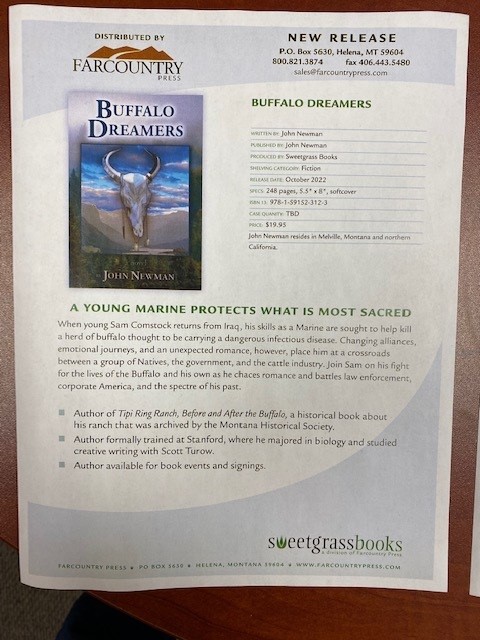
This is the story of Sam Comstock, a young Iraq war vet, who needs to find a way to heal his wounded PTSD soul. Healing is at the heart of the story, and Sam does this through association with a band of Native Americans who are determined to save a remnant herd of Yellowstone buffalo from slaughter. Ironically, Sam’s Marine sniper skills lead him from his home in Nevada to Montana on a mission to help manage an infamous wildlife challenge: killing migratory buffalo outside Yellowstone Park that are presumed to carry an infectious disease for cattle. This places Sam seriously at odds with a renegade band of native warrior-dreamers from across the northern Rockies and Great Basin, who are determined to rescue the buffalo. Sam meets and falls in love with a Sioux woman PhD expert in wolf behavior; a relationship that causes him to be taken hostage by the band. Sam must fight for his life on multiple levels: as a hostage, as potential prey to the growing pack of wolves circling the remnant herd, and more fundamentally as a potentially suicidal veteran. He eventually learns that his Native allies and the buffalo have something vital to teach him about surviving in a hostile world. The theme of acquiring personal power through visionary practices is embodied by Sam’s healing. The story builds to a climactic and bloody showdown that allows Sam to take a first step back from the void.
So there you go. A recent Kirkus Review about the novel stated that Buffalo Dreamers is a “compelling and empathetic story of healing.” Which is just about right. This is a story about PTSD, endangered buffalo, Native Americans, and ultimately yes, about healing, primarily for a young anglo Iraq war vet, but also on a broader more global scale. I’m not Native American and don’t pretend to be. But I am a great admirer and feel that all of us have much to learn from native tribes and people.
To that point, there is so much great literature by and about natives, both fiction and non-fiction. I have been moved and inspired by the works of Louise Erdrich, Mari Sandoz, N Scott Momaday, the poet warrior Joy Harjo, poet laureate of the US, the mystery series by Tony Hillerman and Craig Johnson, the excellent short biography of Crazy Horse by Larry McMurtry. Two non-fiction works that deeply informed me were Bury My Heart at Wounded Knee by Dee Brown – who was not native but had strong personal native friendships – and more recently The Heartbeat of Wounded Knee by David Treuer, an Ojibwe native who takes a fresh look at native history. These two works make the case that the American Indian culture and people died at the 1890 massacres at Wounded Knee, and then, that the Wounded Knee massacre was in fact the start of a resurgence of Native American culture and sovereignty, as evidenced by their continued and growing presence and power.
My personal path with natives began at an early age during high school, when I worked with my parents on a volunteer project to help construct the Ishi Trail in the northern California foothills country where Ishi and his Yana band lived. I was amazed to learn that his small band of survivors roamed the hills above my town of Chico during a time when my grandparents were actually alive, not in ancient history. I later had a similar awakening with the Washoe at Lake Tahoe. I learned about their ancestral homeland at the lake and took language classes at their tribal headquarters in Nevada. I also owned a ranch for a number of years in Montana that turned out to be an important confluence for buffalo hunting tribes, including the Crow, Arapahoe, Lakota, and Cheyenne. Although the ranch was mostly devoted to wheat, hay, and cattle, it did have a series of rimrock cliffs that were known to be historic buffalo jumps. I eventually became friends with some Cheyenne families near Lame Deer and was invited to participate in the Ft Robinson Outbreak Spiritual Run, 400 miles from Nebraska, back through the Black Hills and Pine Ridge rez. The run recreates and follows the path of a small group of Cheyenne survivors who broke free from their prison to return to their homeland. It is a real story of survival and triumph on an epic scale, and it was a privilege to participate as the sole anglo.
Speaking of youthful history, on the two occasions I participated in the tribal run, I had the honor of meeting Chief Oliver Red Cloud, the great grandson of the Chief who signed the 1851 Laramie Treaty, and led the battle at Little Big Horn, and Jenny Seminole Parker, whose father was a participant and survivor of the Ft Robinson breakout. These individuals could recount first hand the stories of conflict and survival that occurred when society was on horseback, a time that seems ancient but in fact is within the memories of people who still move among us. Similar to my early awakening about Ishi, this helped me appreciate how young our history is, and that the lessons to be learned are fresh, painful, and still relevant.
Many of you may know that killing wild buffalo is something that has been going on for a long time. In the 1800’s it was official US government policy to slaughter the herds as a way of destroying the Indians food source, or commissary, and thereby force natives to relocate onto reservation lands, where they could become good little European farmers. The original herds of many millions were reduced to about 23 animals in Yellowstone Park. Through the efforts of George Grinnell and others, the buffalo were saved from extinction, only to face new threats in the 1990’s and onward due to government and cattle industry population management efforts. Ostensibly, according to the Park service and the cattle association, Yellowstone is overrun by buffalo, which presumably also carry brucellosis, a fatal disease for cattle. However, for anyone who has driven through the Park in the last twenty years, the creatures that are crapping everywhere and wandering all over creation are the elk, not the buffalo. And there is not a single case of buffalo transmitting the virus to cattle. But as for the buffalo, this is a battle that is ongoing and far from over. The buffalo are still herded up inside and outside the park, then shipped off for quarantine, and eventually either slaughtered, made available to local hunters to go out and have a big adventure basically shooting a grazing cow, or sent to various native herds. What makes the Yellowstone buffalo so special, is that they are the only pure genetic strain of bison going back 400 thousand years when they originally wandered over the Siberian land bridge into North America, with no inter breeding with cows.
The American Bison, or buffalo, as they are commonly called, are an impressive creature. Since 2016 they are officially the National Mammal. For native tribes in Montana and the northern plains and rockies, the buffalo have always been an essential part of their economy, livelihood, and mythology. Buffalo are revered and honored, and are part of the origin and creation myth stories of many tribes. A buffalo skull is at the center of the Sun Dance, perhaps the most important spiritual celebration. In my novel, the buffalo are at the same moment, irascible, slow to move, fast to charge, close with kinship, a prey animal that can readily defend itself and the herd, but also a creature imbued with spiritual power. A native friend of mine, a deeply wise Cherokee woman, converted me to a belief in Spirit, which underlies all religious belief systems, an elemental power connected to the universe and the life force within each of us. Primordial buffalo are the essence of Spirit. In fact, many tribes, starting with the Lakota and Cheyenne, have a belief system based on an almighty creator, one god which is either syncretic or complimentary to the god of Abraham, much more a disciple than any sort of god. Buffalo are revered not as the golden calf-god as played out in the bible, but as a vital link to the Creator, a messenger, and a vehicle for connection.
In some ways, the buffalo and native peoples have a parallel history, a sort of co-evolutionary relationship. Natives depended on the buffalo for food, tools, and sustenance, many aspects of their societies were organized around hunting and utilizing the buffalo. It was official government policy to exterminate the buffalo, and in many ways to exterminate native peoples as well: bounties were paid for scalps, massacres of whole villages occurred with impunity. Even the 20 soldiers who massacred the unarmed 300 men women and children at Wounded Knee all received Medals of Honor. But the buffalo have survived, as have natives. For the buffalo, there are now strong tribal and governmental forces aligned to promote their well-being. This past July, the Intertribal Buffalo Council signed a Treaty in Banff along with over 40 signatories, to protect the buffalo. Ironically there are still buffalo rounded up, harassed, and killed on the boundaries of Yellowstone Park. But progress is being made, and there is a strong constituency watching, monitoring, and advocating for buffalo protection.
This leads me to the whole topic of PTSD, and more generally the plight of veterans, which is an ongoing major native concern and also central issue in the novel. My protagonist, Sam, suffers from the trauma he experienced in Iraq as a Marine sniper. For him, the trauma is more emotional than physical. He carries two dog tags around his neck, one his own, and the other from a very close friend who was killed in a roadside bomb. But the deep trauma Sam feels is from the highly personal experience of seeing his victims close up on his sniper scope, especially a tragic incident involving a mother and child. He is not alone in that, a US Department of Defense report in 2021 stated: “An estimated 30,177 active duty service members and war veterans of the post 9/11 wars have died by suicide, significantly more than the 7,057 killed in the Global War on Terror operations. This marks a failure by the military and US society to managed the mental health costs of our current conflicts.” Think about that for a moment, the numbers are staggering and profoundly tragic.
PTSD is a gripping threat for Sam. But it is also woven into the DNA of native americans due to the genocidal trauma they experienced at the hands of European settlers, more accurately known as Invaders to the native people. Whole tribes were annihilated by attack and murder, also by deliberate and intentional infection with smallpox. The study of intergenerational trauma is something experienced by other groups, including Jewish people due to genocidal holocaust persecution by Nazis and others, also the experience of South East Asians such as the Hmong who faced genocide in Laos. What’s amazing about all this for natives, is that they enlist and serve in the military in numbers that are highly disproportionate to their share of the population. This is not simply a matter of patriotism, perhaps more of a warrior society defending their homeland, even if it is now shared with European neighbors and invaders. In addition, there is a strong identity and sense of respect in native communities for veterans. Young recruits are honored and blessed when they leave for boot camp, and upon return from service. Veteran’s groups are some of the most vital organizations in the community.
My father was a proud Navy veteran, but he carried deep scars from his service in the Pacific. We talked a lot about this, and over time I was struck by the difference between the way natives honor and work with veterans, compared to the disregard and in some cases outright disrespect given to non native veterans. I admit that is a broad generalization, but it applies to the experience in my own family, with many veteran friends, and to what I have personally witnessed in native communities.
All of this builds within Sam’s journey through the novel. He starts out as a psychologically crippled young man, who visits his father at an Alzheimer’s home, in the naïve hope that perhaps Alzheimer’s will be contagious and allow him to forget his painful memories. When he casts his lot with the native group trying to save the remnant herd of buffalo, he begins to discover a new way of healing, and harnessing his own personal power. One of the scenes in the book involves a big storm settling over the group and herd. What’s instructive and amazing about buffalo, is that unlike domestic cattle which drift along with the wind, buffalo instinctually face their big battering ram heads right into the wind and push forward through the storm. It’s easy to believe that over millenia of such storms, they learned the deep wisdom of facing and attacking a storm, rather than being a victim and letting it blow you down the trail, almost certainly prolonging suffering and probably leading to death. Sam learns to do the same thing with his life, and in an important sense, he discovers his own buffalo spirit.
 Buffalo Dreamers