After devastating winter, groups renew push to change Yellowstone bison management

Original article

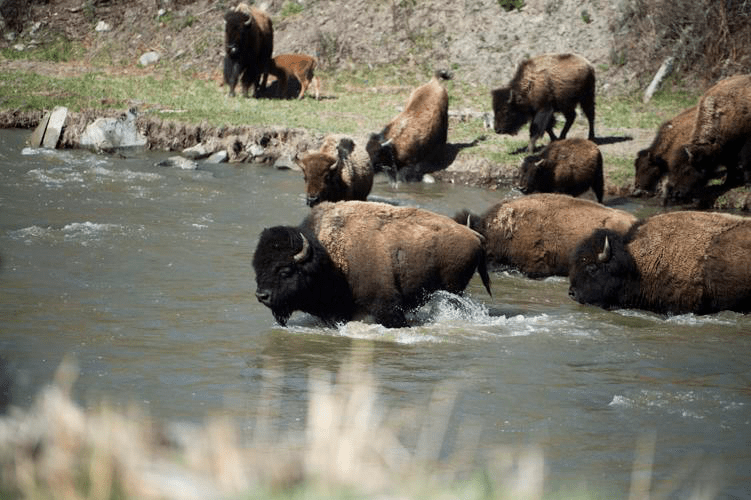
Buy NowBison cross the Gardner River in Yellowstone National Park on Thursday, May 4, 2023.Samuel Wilson/Chronicle/Report for America

Calls to change how Yellowstone bison are managed have been given new life this spring, following the deadliest year on record for the national park’s wild herds.

Nearly 1,200 bison were killed by tribal and state hunters this year, after a harsh winter drove the animals to leave the park in high numbers. That’s close to one-third of the park’s bison population, which hovered around 6,000 at last count.

Aerial footage from wildlife groups show the bison cull near Gardiner, where blood and scattered carcasses, picked over by birds, litter Beattie Gulch.

The animals leave in search of better food and calving grounds. But once the bison cross outside their defined range, they can be shot by tribal and state hunters.

The hunt is the result of decades of debate on how to best manage bison in the Yellowstone ecosystem. Because of their genetics, the Yellowstone herds are important to Native tribes — but also deemed a threat by the state’s livestock industry from their potential to spread disease.

It doesn’t have to be this way, environmental groups and tribes say. The deadly winter has again fueled calls for alternatives — like expanding allotted habitat for bison and returning the animals back to Native people. But there are still steep political barriers to any changes.

In exploring solutions, the goal is to get as many Yellowstone bison as possible out of the park alive, said Scott Christensen, executive director of the Greater Yellowstone Coalition.

Managers must cull a certain number of bison annually, so the ecosystem doesn’t get overrun with animals. The Yellowstone bison population has recovered from under 500 animals in 1965 to around 6,000 today.

The cull number is decided by officials involved in the Interagency Bison Management Plan. Created in 2000, the group brings together eight stakeholders, including the National Park Service, Montana Fish Wildlife and Parks, Montana Department of Livestock, and the Intertribal Buffalo Council, to collaborate on managing bison.

But last November, the agencies couldn’t agree on a target population for the bison herds — so no specific cull number was set.

That non-decision meant there was no guidance for how many animals hunters could take. As of April 17, the park reported a record year, removing 1,548 bison from the park population. There were 1,172 animals killed by hunters, 94 consigned to slaughter, and 282 enrolled in a transfer program to tribes.

The cull numbers are always higher in years with harsh winters. In other years, few bison leave the park — in 2021, no animals were removed, and in 2022, only 50 were.

Even still, this year’s numbers are record-breaking. The last winter with comparable numbers was 2007-2008, where roughly 1,350 bison were culled. That year, hunters killed only 166, and 1,087 were sent to slaughter.

Now, hunting is the primary method to manage the population. But there are concerns about the hunt’s severity and safety that could be addressed if the area where bison could roam was bigger, Christensen said.

Hunting occurs when the bison migrate onto tolerance zones around the park — north of Gardiner 11 miles to Yankee Jim Canyon, and west of West Yellowstone onto Horse Butte and the Taylor Fork drainage. Those zones were established to support hunting and limit the hazing of animals back into park boundaries.

But outside of those tolerance zones, wild bison aren’t allowed in Montana, including on public land. That’s because they risk spreading brucellosis, a disease also spread by elk that can cause cattle to abort or produce weak young.

Existing tolerance zones could be improved to accommodate more animals, Christensen said. That means building wildlife crossings and using prescribed burns to recover more native grasses for feed. The Taylor Fork tolerance zone is rarely used by bison, because it’s near impossible for them to access it.

Federal government studies have also found Charles M. Russell National Wildlife Refuge in central Montana a prime place for wild bison restoration, as there’s no cattle grazing in close proximity.

But efforts to move more bison onto public lands in Montana have been stonewalled, both through lawsuits and legislation to prevent any bison restoration in the state.

This month, the Montana Legislature passed a joint resolution opposing wild bison grazing on the CMR refuge, even though the land is federally owned.
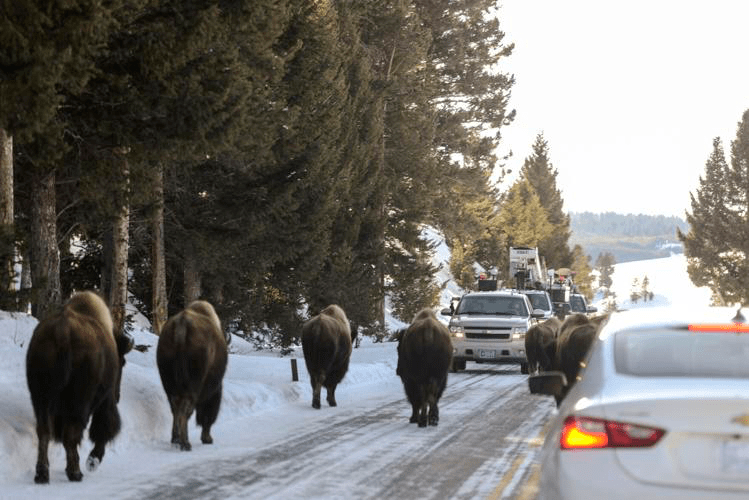
Buy NowCars are stuck in a bison jam on Northeast Entrance Road in Yellowstone National Park on Feb. 16.Rachel Leathe/Chronicle

Livestock industry interests have resisted compromising about bison restoration in any capacity, and that resistance is stalling progress on the issue, Christensen said.

“Until we can get to the heart of the issue and start to come up with some workable solutions — which I believe there are many — we’re going to be stuck in this cycle of consternation and conflict,” Christensen said.

Yellowstone National Park declined multiple interview requests for this story, saying park staff were busy and there was nothing new to comment on.

Other groups are working to expand bison range outside Yellowstone through returning disease-free animals to tribes.

Jason Baldes, vice president of the Intertribal Buffalo Council and member of the Eastern Shoshone Tribe on the Wind River Reservation, has helped restore bison to 65 tribes across 20 states.

The Yellowstone bison are specifically important to tribes because of their genetics, Baldes said. The Yellowstone herds are ancestors of the last buffalo that remained after they were nearly exterminated by colonizers in the 1800s.

“It’s very important that we get this buffalo back into our diet. It’s important that we restore them to our landscapes. It’s important that people understand the history of what happened to the buffalo and similarly happened to Native people.”

Some of the bison in the Eastern Shoshone herd came from the Fort Peck Indian Reservation as part of Yellowstone’s transfer program.

Robert Magnan, director of Fish and Game for the combined Sioux and Assiniboine Tribes, who also oversees the bison transfer program, said since its launch in 2019, the program has distributed some 300 Yellowstone bison to 28 different tribes across 14 states.

In its first year, the program started with just five animals. But this year, that number expanded to over 100, and it’s expected to be even higher next year.

The program can transfer disease-free animals to tribes after a nearly two-year quarantine process, which tests the bison for brucellosis every few months.

“The importance is it gets the buffalo out of the park alive instead of just killing them,” Magnan said of the program. “But I feel sad for the bison. It’s been years we’ve been doing these quarantines and we’ve never, ever had a positive case.”

Magnan noted the thousand-plus animals that were killed this year coming out of the park — animals he said are worth keeping alive, despite politics.

“What makes me so mad is they don’t test to see if they have brucellosis or not. They just round them up and slaughter them. There could have been some good animals that we could have taken care of,” Magnan said.

That’s what drove the Eastern Shoshone tribe from participating in the bison kill, despite their treaty rights to do so, Baldes said.

Eight tribes have exercised their treaty rights to hunt the Yellowstone bison outside the park, but the competition and limited space for hunting makes the practice dangerous, Baldes said. One member of the Nez Perce tribe was accidentally shot by fellow hunters this fall.

Baldes described it as a slaughter rather than a hunt because Yellowstone bison have adapted to not fear people. That means they won’t run when approached by a human with a high-powered rifle. They cross the invisible park boundary and are gunned down.

“It’s good for these tribes to be exercising their sovereignty and their treaty rights,” Baldes said. “But we have to recognize that Montana opened up the hunt to the tribes to use them as a scapegoat to do their own dirty work.”

While state leaders have hailed the bison cull as an important part of native cultures, “they don’t really appreciate or respect sovereignty or self-determination in any other instance, except for this one, when the tribes can be used as their pawn to slaughter these animals on their behalf,” Baldes said.

But other native hunters, like Tom McDonald, chairman of the Confederated Salish and Kootenai Tribes on the Flathead Reservation, say the hunt is important for both treaty rights and population management.

Anytime native people can engage in bison hunting like their forefathers did, considering the cultural and spiritual significance, it’s a good day, McDonald said.

“Of the tools you can use to reduce the buffalo to the carrying capacity — as defined by all the contemporary issues today — hunting is always the primary way to manage any wildlife population,” McDonald said. “To return our people to that landscape in such a meaningful way, it’s a win-win.”
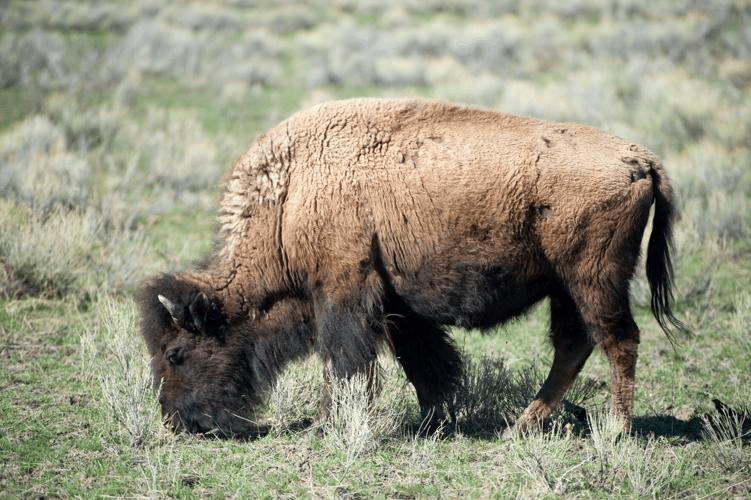
Buy NowA bison grazes near the North Entrance of Yellowstone National Park on Thursday, May 4, 2023.Samuel Wilson/Chronicle/Report for America

The Department of Livestock said the carrying capacity of Yellowstone’s habitat is an important factor for bison management, given how fast the animals can reproduce. Decisions aren’t only driven by the threat of brucellosis, said Montana state veterinarian Marty Zaluski.

Removal of bison from the ecosystem has to happen, regardless of whether they have brucellosis, Zaluski said. But because some 60% of Yellowstone bison have been exposed to the bacteria that causes the disease, their options for relocating are highly limited or shut off.

Because of its wildlife, Montana is one of three U.S. states to have additional safeguards to prevent brucellosis from infecting cattle, Zaluski said.

The state has a designated surveillance area around Yellowstone, where cattle are at elevated risk for brucellosis because of overlapping range with bison and elk.

Managing the DSA involves testing 90,000 cattle annually and costs the state about $2 million a year, Zaluski said. But it’s the lynchpin for Montana’s brucellosis-free status, which allows ranchers here to export cattle with fewer testing requirements.

Montana lost that status once in 2008, when brucellosis was found in two herds two years in a row. That meant ranchers were subject to 19 different testing requirements and lost market opportunities from other states — ultimately costing the Montana cattle industry between $5 and $15 million, Zaluski said.

Still, officials found it was likely elk that spread brucellosis to those cattle, rather than bison. There hasn’t been a recorded case of bison to cattle transmission for brucellosis.

Just because there hasn’t been a case doesn’t mean the risk isn’t there, Zaluski said — more bison have been exposed to the disease than elk have.

“When you compound that higher level of disease prevalence with the fact that bison use geography and winter range in a way that’s much more similar to cattle than elk do, that makes it really difficult to say that bison and cattle can be out on the range together,” Zaluski said.

The state has already done what it can to restore bison, and the range around the park for them has slowly expanded, Zaluski said. Moving wild bison elsewhere in the state would probably require another costly surveillance area, he added.

“The challenge with bison management is that the easy answers, the low hanging fruit, have been picked already,” Zaluski said. “We have already allowed bison to an area that is manageable and mitigated the risk to cattle.”

“Going forward, I don’t see an easy way for us to continue that range expansion,” Zaluski said.

Still, some groups have called upon the federal government to intervene. The Gallatin Wildlife Association sent a letter to U.S. Secretary of the Interior Deb Haaland, Montana Democratic Sen. Jon Tester, and leaders in the Forest Service and U.S. Department of Agriculture, asking them to do something about the management situation.

“The bloodshed from killing defenseless bison flows deeper and redder than ever… we are allowing these herds to be decimated, suffering, and injured, while at the same time, many officials seem to behave in willful ignorance to the severity of the problem,” Gallatin Wildlife Association President Clint Nagel said in the letter.

“We firmly believe you could help develop a better, more scientific approach in bison management should you choose to do so,” Nagel wrote.

The federal government has the authority to move bison to federal lands, like the CMR wildlife refuge, Nagel said. As of Wednesday, no one had responded to his letter.

The Alliance for the Wild Rockies sent a similar letter, asking for the federal government to use its authority to expand bison range.

The group has also helped sponsor eight billboards throughout the state, reading, “It’s not a hunt. It’s a slaughter,” to raise public awareness about bison management at Beattie Gulch.

Both wildlife groups are also petitioning for the Yellowstone bison to be listed as endangered. The species is up for consideration for listing, after the U.S. Fish and Wildlife Service opened a year-long study to explore the option last June.

That would shut off hunting opportunities for the buffalo until its population recovers enough to warrant delisting, said Mike Garrity, director of the Alliance for the Wild Rockies. It would also force managers to agree on the animal’s carrying capacity in the Yellowstone ecosystem.

“Having the state of Montana decide how to solve this problem — it’s like asking Mississippi to solve the civil rights problem in the 60s. They were part of the problem,” said Mike Garrity, the alliance’s director.

“The federal government stepped in then, and the federal government needs to step in now to (protect bison).”
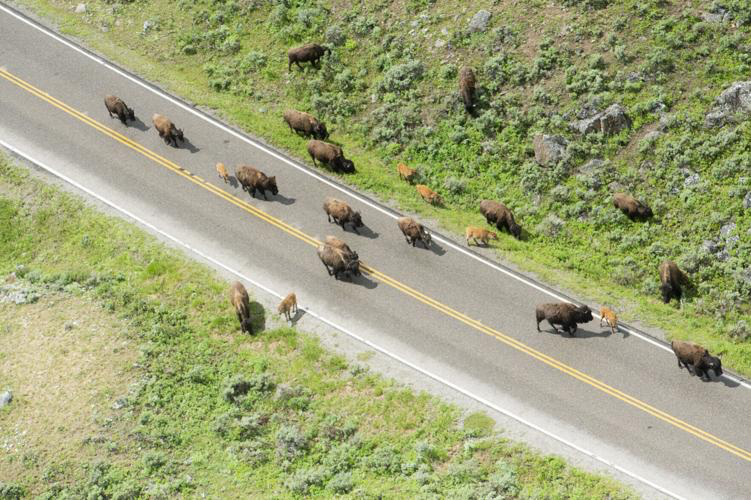
Buy NowBison loiter on the North Entrance Road in Yellowstone National Park on Sunday, June 19, 2022.Samuel Wilson/Chronicle/Report for America

Isabel Hicks is a Report for America corps member. She can be reached at 406-582-2651 or ihicks@dailychronicle.com.
Livingston Enterprise

Udder chaos in Livingston: Local rancher moves his cattle through town the old fashioned way

Original article

  • JOHN CARROLL Livingston Enterprise
  • Mar 17, 2023
Livingston cattle drive
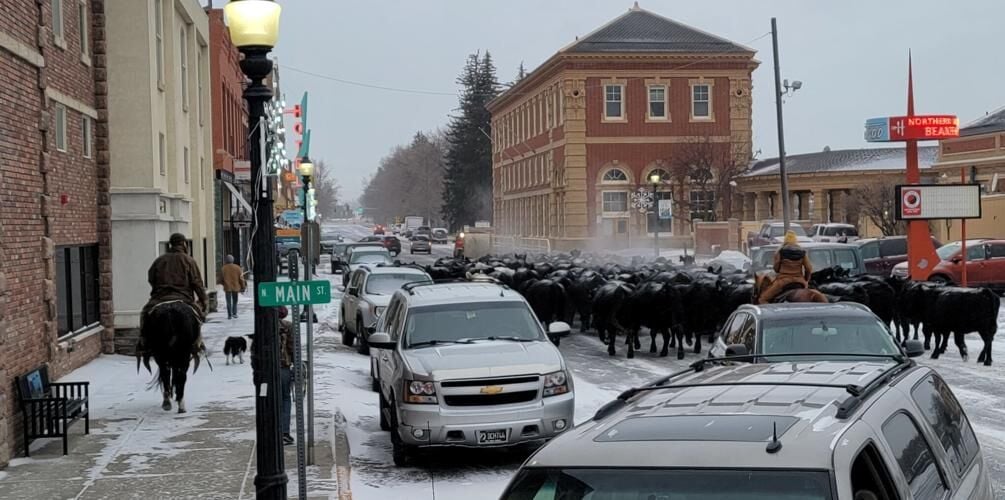
Passing cars on Park Street maneuver through a minefield of ice, snow and cows on Sunday in Livingston.Photo courtesy of Donald Zanoff

JOHN CARROLL Livingston Enterprise

Livingston rancher Matt Jesson had a plan to get his cattle home on a recent winter day.

For the last six months, Jesson’s cows had been grazing on the west side of town on leased property off Swingley Road.

Now it was time to get the cattle home to his property on U.S. Highway 10 for calving season and vaccinations.

Typically, Jesson loads his 150 cows on multiple trailers and drives them to their destination. But the process can be arduous and time-consuming, said the rancher, and sometimes it takes most of the day.

On a cold, blustery morning in Livingston, local ranchers guide cattle down Park Street on their way to the Jesson Ranch located on U.S. Highway 10 West.Photo courtesy of Donald Zanoff

So this year, Jesson decided to do something different. The 62-year-old rancher decided to drive his cattle about 10 miles down local roads and highways, a route that took them them right down Park Street and through the heart of Livingston.

“I was going to sneak them through town early Sunday morning,” said Jesson. “But a lot of people showed up, and a lot of cars, too.”

Some of the cattle got spooked by the cars, said Jesson, and tried to escape the herd down alleyways and side streets. But the handlers on horseback and herding dogs were able to keep the cows on course with a little help from their friends.

Cattle from the Jesson Ranch move slowly through town on Sunday morningPhoto courtesy of Donald Zanoff

“People on the sidewalks were helping us,” said Jesson. “It was greatly appreciated.”

Jesson said the cattle departed Swingley Road around 6:30 a.m., and that he had alerted the sheriff’s office in advance about his plan and route.

“There’s no laws against it,” said Jesson. “We had the right of way.”

The slow-moving bovine parade took about two-and-a-half hours to get to their destination on U.S. Highway 10.

This was the first time that Jesson had ever walked his cows through town. He said the operation went so well he may do it again in the fall.

“It worked good,” said Jesson, whose ancestors have been ranching in Park County since the 1880s. “We saved money and made good time. I’m tired of hauling them. It’s a much longer process. Plus, we didn’t have to clean trailers.”

Play video

Senator Daines shares fourth generation Montana rancher Maggie Nutter’s story about unfair pricing in the cattle market that’s impacting her ranching operation in Sweetgrass.

Video slideshow of vintage Billings postcards

Billings Gazette

Activists decry bison ‘hunt’ north of Yellowstone National Park

Original story

Play Video

Buffalo Field Campaign has filmed hunters firing at bison toward the highway, placing drivers at obvious risk. 

In 18 years of working to protect Yellowstone National Park bison, advocate Stephany Seay said she has never seen such a slaughter.

Tribal hunters have shot just over 400 bison, while state hunters have killed 55 so far this winter. The majority were killed in the Gardiner Basin on Custer Gallatin National Forest land, just north of the park’s northern boundary. The National Park Service has killed 13 bison wounded by hunters that walked back into the park and another 37 were listed as unknown deaths, according to park data. In addition, tribal hunters have reported killing 13 elk in the region.

STATE & REGIONAL

Listen to our Montana Untamed podcast:

  • Lee Enterprises

“It’s a killing spree,” Seay said, with bison entrails littering the landscape, including bison fetuses left after pregnant females were killed.

What bison advocates characterize as a slaughter, however, is the exercise of eight tribal nation’s long-held treaty rights, as well as a source of healthy, lean protein for economically depressed reservation residents. Having the bison killed by tribal members also lessens the pressure on Yellowstone officials to capture bison and ship them to slaughter houses for butchering, a management action that’s long drawn criticism for being inhumane.

Seay and other bison advocates’ concern comes as the U.S. Fish & Wildlife Service is studying whether to protect Yellowstone’s bison under the Endangered Species Act. The large, shaggy animals — which have bounced back once from nearly being exterminated by commercial shooters in the 1800s — were designated the national mammal of the United States in 2016 in part because of their conservation.

Firing line

Seay said her nonprofit group, Roam Free Nation, acknowledges tribal members have every right to hunt bison, but questioned the nature of the bison harvest since the animals are often shot at or near the park border. As a result, the boundary has at times become a firing line. In mid-January, one Nez Perce hunter was grazed by another hunter’s bullet.

The Park County Sheriff’s Office investigated the incident, but no charges were filed. “The state, Forest Service and tribes continue safety coordination efforts so the Forest Service does not see an imminent health and safety threat that would constitute an access closure to National Forest System lands,” Marna Daley, Custer Gallatin National Forest public affairs officer, wrote in an email.

“He got lucky the bullet wasn’t two inches over,” said Nathan Varley, a longtime Gardiner resident and businessman. “If the Forest Service needed a case to close the hunt area, that would be it.”

Bonnie Lynn, who lives and operates a cabin rental business near Beattie Gulch, said the entire ecosystem is being negatively affected by the hunting as raptors and scavengers dine on the scattered internal organs, possibly ingesting poisonous lead from hunters’ bullets. In 2019, she counted 358 bison gut piles left on forest land near her home.

“This is a national wildlife disaster,” she said.

Lynn said the bison have no natural fear of humans after seeing thousands of tourists throughout the summer. She has unsuccessfully sued to try and halt the hunts, but vows to continue to be a “voice for the animals that do not speak.”

Tribal representatives contacted did not respond in time to comment for this story.

Gut piles from bison killed north of the Yellowstone National Park border are scattered across a field near Beattie Gulch on Custer Gallatin National Forest land.Stephany Seay, Roam Free Nation

Borderland

Beattie Gulch is one of the first Forest Service properties where hunting can begin north of the park. The other main hunting area in the region, Eagle Creek, is located on a mountainside above the community of Gardiner. Once past these constriction points, there’s more room for the bison to spread out, known as the tolerance zone. The zone ends near Yankee Jim Canyon, about 15 miles north.

Lynn won’t rent out her cabins across from the gulch in winter because of the rifle shots ringing out day after day. She said hunting began earlier this year, starting in November instead of January, and has remained fairly steady. Depending on the weather, hunts in the past have continued into March. Lynn blamed cold weather and heavy snow for pushing bison out of the park this winter as they seek a source of food.

As of Jan. 30, more than 450 bison were north of the park boundary in the Gardiner Basin with another 700 spread out in the roughly 8 miles between Mammoth Hot Springs and the park’s border, according to data from the National Park Service.

This winter’s bison migration is the largest seen in more than a decade, said park superintendent Cam Sholly.

As of October, Yellowstone officials estimated the bison population at more than 6,000 animals, up 27% from 2020. Year to date, including bison being held in the park’s Stephens Creek capture facility for possible entrance into a quarantine and tribal transfer program, more than 1,000 bison have been removed from the population. The Park Service recommends against the removal of more than 1,500 animals. Depending on the final hunter harvest numbers, the Park Service may release some of the captured animals.

Hunters approach two downed bison during a hunt this winter in the Gardiner Basin.Stephany Seay, Roam Free Nation

Transition

Large numbers of Yellowstone bison have been killed in the past. In 2008 more than 1,600 were shot by hunters or sent to slaughter, with another 700 dying within the park due to a harsh winter. Two years ago and then four years ago, 1,200 bison were killed each winter.

The difference is that this year the Park Service is sending fewer animals to slaughter. So far this year, 88 bison have been captured by the agency and shipped to slaughter with the meat given to tribal partners. But Sholly has committed to “substantially reducing” such shipments while “supporting increased tribal and state hunting outside of the park boundaries.”

A Park Service graphic shows shipment to slaughter peaking in 2008 and on a steady decline since the winter of 2017-18. The last two winters were mild enough that few bison migrated out of the park. There is no hunting allowed inside Yellowstone.

The Park Service also captures and tests animals for possible entrance into a quarantine program. After passing successive tests to ensure they don’t have brucellosis, the fenced-in animals can be transferred to the Fort Peck Tribes’ quarantine facilities in Eastern Montana for the final round of testing before they can be shipped to participating tribes. So far, almost 300 bison have been transferred through the program, with the latest shipment of another 112 head this winter.

A Yellowstone National Park bull bison emerges from the trees with its face covered in snow. The animals use their heads to clear snow to reach food underneath.A. Falgoust, NPS

Disease

The bison are quarantined and limited to the tolerance zone out of fear of spreading brucellosis. The disease can cause pregnant cattle to abort. The main way the disease can be transferred is through a pregnant animal’s contact with birthing fluids from an infected female. Yet male bison are also subject to quarantine and are killed by the Department of Livestock if they wander past the tolerance zone.

Brucellosis outbreaks in cattle herds are costly for ranchers, requiring quarantine, testing and removal of infected animals. Adjacent herds must also be tested. Failure to follow the procedures can result in the loss of the state’s disease-free status, which makes interstate movement of cattle difficult and restrictive.

The bison quarantine program is constrained by the number of animals that can be held near Gardiner, about 250. The quarantine facility on the Fort Peck Reservation could handle more bison, but the state of Montana won’t allow the bison to be shipped there until they have repeatedly tested disease-free.

Under quarantine protocols authored in 2003, the U.S. Department of Agriculture’s Animal Plant and Health Inspection Service requires the park to quarantine sexually mature bull bison for one year, with sexually immature female bison requiring two-and-a-half years of quarantine.

Hundreds of Yellowstone bison have migrated north this winter in search of food due to heavy early snow and cold temperatures that locked food under ice.Jacob W. Frank, NPS

Restricted

Because of the threat of brucellosis spreading, the state of Montana has not allowed bison to roam freely. Instead they are confined to tolerance zones just outside the park’s North and West Entrances in Montana. Elk, which also carry brucellosis, are not similarly restricted, but the state does have a program to try and keep elk separated from cattle and also monitors the spread of the disease in what’s called the designated surveillance area.

All of the legal gymnastics come from a court-mediated settlement in 2000 which created the Interagency Bison Management Plan. The coalition of tribal nations, state and federal agencies works together to make bison management decisions. The settlement came after Montana sued the Park Service to protect cattle ranchers from bison infecting herds with brucellosis. Bison are the only wildlife in Montana under the control of the Department of Livestock.

The bison advocacy group Buffalo Field Campaign, based outside West Yellowstone, has touted a possible legal argument to challenge Montana’s treatment of bison.

BFC has posted online and written in its newsletter its belief that “once a court determines that an Indian tribe has retained the right to hunt and fish at sites off their reservation, the protection of federal recognition attaches in such a way that Indian Americans acquire rights superior to non-Indian Americans … Moreover, courts hold that off-reservation hunting and fishing rights obligate the state to ensure the availability of a fair share of game and wildlife to treaty tribes … Montana has done just the opposite, of course, including forcing the federal agencies to enter into an oppressive bison management regime that has seen over 12,000 wild bison senselessly slaughtered.”

BFC continued, “That renewed pogrom on bison, experienced as trauma by Native Americans, has never formally been sanctioned by the courts — including in the case from which it sprang, which was dismissed by consent of the parties upon entering into the negotiated management plan.”

Kekek Stark, a law professor at the University of Montana, said after studying the group’s published account at the Billings Gazette’s request, that he interpreted the group’s argument as: Since tribal hunting rights are guaranteed, the state has no right to not let bison roam outside the park so they can be hunted.

“It seems to me that the group is arguing that 1) the bison should be free to roam in its original habitat, including outside the park, 2) while roaming, the state does not have unfettered discretion in how the bison are managed, i.e. culling to protect livestock, and 3) treaty tribes should be able to harvest them,” Stark wrote in an email. “There are legitimate legal arguments for all three positions.”

In comparing BFC’s legal arguments to Northwest tribes’ claims regarding salmon fishing, Stark said, “If a regulation is restrictive of treaty rights it must be necessary for conservation purposes.”

A nearby county road provides close access for bison hunters to load animals they have shot north of Yellowstone National Park.Stephany Seay, Roam Free Nation

Progress

Although much has changed regarding bison management in the past 30 years, it has been incremental, slow and buffeted by politics at the state and national level.

Lynn said it will take “the court of public opinion” to halt the slaughter. That happened in 1990 when protests gained national attention. Back then, park rangers were planning to shoot female bison that left the park. Calves could be captured, sterilized and sold live. State hunters were allowed to kill bulls, being escorted to the animals by game wardens. At the time, the bison herd was much smaller, only about 2,500 animals.

When the national group Fund for Animals sued in 1991 to halt the killing, U.S. District Court Judge Charles Lovell wrote, “Montana has an absolute right under its police powers, in protecting the health, safety and welfare of its inhabitants, to remove by reasonable means possibly infected trespassing federal bison which migrate into Montana.”

In the wake of national television attention regarding protests of the harvest, the Montana Legislature banned bison hunting in 1991. The ban was lifted 15 years later, but was closely regulated with low harvest numbers. In 2009, the Confederated Salish and Kootenai Tribes, Nez Perce and InterTribal Buffalo Council joined the Interagency Bison Management Plan after claiming treaty hunting rights. Five other tribes now claim similar rights, but Nez Perce and CSKT account for the majority of the bison harvest.

Tribal hunts are regulated by tribal officials. The Montana Department of Fish, Wildlife & Parks polices only state licensed hunters, and Montana license numbers are limited. The state issues 50 either-sex licenses each year but can release up to 100 cow/calf licenses if there is a large bison outmigration.

Hunting?

Calling the killing of bison in the Gardiner Basin “hunts” ignores what most students are taught in hunter education classes about fair chase. The Boone & Crockett Club defines fair chase as the “ethical, sportsmanlike, lawful pursuit and taking of any free-ranging wild animal in a manner that does not give the hunter an improper or unfair advantage over such game animals.”

Seay said her group “fully supports treaty rights and tribal sovereignity,” but has a hard time justifying the killing of so many bison in such a small area.

“I see no end in sight unless somebody stands up and says something,” she said.

Review

Hi John,

    Thank you for the autographed edition of your novel, Buffalo Dreamers. I found it hard to put down, and I enjoyed it very much.

    The Buffalo Dreamers focuses on some Montana issues that aren’t going away soon and provokes important conversations. I am reminded of those conversations every morning that I see the bison on the hill across the road from our Fort Peck home (in a wildlife exhibit). And I am likewise reminded whenever I partake of buffalo meat at a native feast or celebration. Bison from Yellowstone and elsewhere replenish and revitalize native herds on all seven of our reservations now, I think, so perhaps the situation you write about has something of a happy ending. I am not sure the slaughter has stopped, but I think it has at least been minimized…

    Your book, I should think, still has traction with people (both liberals and conservatives) on and off the plains who have a distaste for heavy-handed government “problem-solving.” While free-roaming bison can destroy farmland and fences, and brucellosis  is still a problem with park bison and elk, there has been both better management by the government and less opposition from farmers and ranchers in the park vicinity.

    Schools in small Northeastern Montana towns are bleeding students and the small towns are dying. While American Prairie has courted native support by donating bison to Indian tribes, nothing has been said about what is going to happen to the natives themselves, who will eventually find all of the infrastructure they depend on disappearing along with the euro population of the plains. Nowhere in anybody’s propaganda is there anything about restoring Indians to the plains.

    As a teacher on and off the reservation in Northeastern Montana for almost 50 years, and a resident of Eastern Montana for almost 60 years, I have witnessed a lot of boom/bust, but despite that–and for a lot of different reasons–there has been a steady drain of population, but also a steady amalgamation of non-agricultural land. The Charles M. Russell National Wildlife Refuge, which I live next to, encompasses nearly a million acres, and the burgeoning American Prairie Reserve now has almost 500,000 acres. The rest of the land is checkerboarded, much of it belonging to the Bureau of Land Management (which owns a little over 8 million acres in Montana), the forest service or the state. Most ranches in this neck of the woods lease very large tracts of public land. Reservations will soon be inhabited land-locked islands with no place for natives to escape to.

    As easy as it is for residents of the plains to blame wrong-headed environmentalists for what is happening in Montana and other plains states, that is not accurate. The real blame belongs to the industrialists of the early 1800s, who wanted to build railroads, sell machinery, build factories, and so on–they encouraged development of the Louisiana Purchase and deluded homesteaders who thought they were getting great agricultural land. Those settlers were also ignorant of the climate, the geographical state (high desert) and the absence of water. Most were gone off the land by the end of the Depression. Reservations were shrunk to make more land available for settlers. Machines began to displace human labor on ag land. However, whose fault these continuing problems are is probably irrelevant. We need to focus on solutions, and in order to find them we are going to have to rethink our priorities. How much ag land is necessary for America to be self-sufficient in food? If essential goods are to be transported across the great plains–on the two main corridors that pass through Montana, for example–how important is it to maintain essential services along those routes? If our borders are mostly semi-wilderness, how secure will they be? How can we protect the Mississippi River and its tributaries?  All of the water between the mountains of the east and west coasts is in them. There are a lot of questions that aren’t being asked. I think I’ll try to provoke some. 

    All my best,

    Roger

  • This article is edited for privacy.

Publishers Weekly/Booklife Review

Here is a third party review from Publishers Weekly/Booklife

Buffalo Dreamers is Newman’s novel about the way of the buffalo—and about those looking to preserve this way of life, and those looking to thwart it. Set in rural Montana, it opens with Sam Comstock, an Iraq war veteran looking to heal past traumas in his new job with the Montana Fish and Game Department. Sam starts off killing migratory buffalo presumed to have an infectious disease, but a slew of unexpected encounters transform both his outlook and the task he has set for himself. His run-in with Lakota-Indian tribe woman turned-PhD-graduate Kate, tribal leader Crazy Wolf, and scar-faced Medicine Dog soon hurl Sam onto the way of the buffalo, his life’s mission becoming to save these wild animals, come what may.

Right from the start, Newman draws a contrast between two ways of life: on the one hand are the Lieutenants and cowboys and wildlife service officials who embody a distinctly Western sensibility that sees the buffalo as a nuisance to be eradicated. On the other are Native American tribesmen and women, whose “whole identity as a people is embedded in the buffalo living free.” Newman deftly establishes perspectives of each side, attentive to drifts of mind and language. The novel teems with army and Marine jargon, as well as references to Native American tribes, customs and rituals, giving the narrative a raw authenticity.

At times, the storyline can get a bit convoluted, and even far fetched. But overall, Newman exhibits a strong hold on the subject matter and a deft hand for summoning the mud and majesty of his terrain in language. His knowledge of wildlife and the terrain is clear, and lends the story robust, lived-in detail and a strong sense of verisimilitude. Lovers of wildlife and adventure stories, and those who enjoy stories of personal growth and transformation will relish this book.

Takeaway: Lovers of wildlife and adventure stories will relish this novel about the way of the buffalo.

Great for fans of: Adam Shoalts’s Alone Against the North, N. Scott Momaday’s House Made of Dawn.

Production grades
Cover: A
Design and typography: A
Illustrations: N/A
Editing: A
Marketing copy: B

HISTORY IS YOUNG

The Battle at Little Bighorn in June, 1876, and the Fort Robinson Outbreak Massacre in September of 1878, seem very long ago, almost like ancient history.  These important historical events took place on horseback, at a time when Montana and the west was occupied and ruled by sovereign native tribes, but facing an invasion from American and European miners, traders, soldiers, and settlers.  In retrospect, the outcome of that genocidal conflict seemed inevitable.  And too often, history is written by the victors not the victims.  But at that time, and in those places, native people and their leaders resisted, fought, and succeeded both physically and spiritually, to assert their independence.

I was in Pine Ridge some years ago and shook hands with Chief Oliver Red Cloud, the great grandson of Chief Red Cloud who signed the Treaty of Fort Laramie, and planned the battle at Little Bighorn.  Chief Oliver spoke to a group of young natives and described hearing firsthand about the battle.  He also emphatically exhorted them to never go back on their treaty rights.  I realized he was speaking with the power of someone who had direct personal experience of history.  On another occasion, I met Grandma Jenny Seminole Parker, whose Cheyenne father was a survivor of the Ft Robinson Breakout.  She told me that as a young woman she did not like white people, because of the terrible things they did to her people.  Later, she married a white man and softened her views, but the fire still burned hot in her heart.  She spoke to the participants of the Spiritual Run and told them to never forget the sacrifices made by their ancestors to guarantee them a tribal homeland.

I felt honored to stand with both these individuals and have the opportunity to speak personally with them. 

Kirkus Review

Here is a “recommended” review from a trusted third party professional source:

BUFFALO DREAMERS

BY JOHN NEWMAN ‧ RELEASE DATE: 9/22

A psychologically scarred Iraq War veteran casts his lot with a diverse group of Native Americans desperately trying to save a band of bison from slaughter in Newman’s modern Western novel.

Sam Comstock is under contract with the Montana Fish, Wildlife & Parks department to use his skills as a former U.S. Marine sniper to individually cull old and infirm wild buffalo. But Bob Smith, the president of the Montana Livestock Association and owner of a slaughterhouse, has something more radical in mind: an indiscriminate massacre of an entire group of buffalo, healthy or not, due to fear that a diseased animal could infect his healthy cattle; he doubles down on his assertion when a dozen strays escape the carnage. One of the surviving animals is a healthy, “pure white”calf; Sam rescues the animal from Smith’s group of buffalo killers, but during the battle, he’s taken captive by a group of Native Americans of various nations that hold “only a loose allegiance, if at all, to one another.” They’re united only in their quest to bring the remaining buffalo home and protect the calf, which all the Native Americans consider sacred. At first, Sam is combative with his captors, but they recognize his inner pain and need for healing. Over the course of this novel, Newman writes with a vivid sense of place (“The snow fell all night, cleansing the blood-stained ground and creating a white canvas upon which creatures large and small could paint the tracks of the new day”) and a palpable respect for Montana’s land and its many denizens. Smith is something of a one-dimensional villain that would have benefited from deeper character development. However, Sam’s captors are depicted with a sense of depth and great sensitivity. The scenes involving the slaughter of bison and cattle are certainly brutal (“the blood now flowing freely across the roadway, the men tracking it every direction”) but not exploitatively so.

A compelling and empathetic story of salvation.

Kirkus Reviews, 8/4/22